


How AI Is Changing Custom Kitchen Design
How AI Is Changing Custom Kitchen Design
Custom kitchen design has always been about personalization.
Homeowners choose cabinetry, materials, appliances, finishes, fixtures, and architectural details to create a kitchen that feels uniquely their own.
But there has always been one difficult part of the process:
turning an idea in someone's mind into something everyone can clearly see and understand.
A homeowner may know that they want a warmer range hood, a more sculptural shape, a darker copper finish, or a sink with a distinctive apron design—but describing that vision with words alone can be difficult.
Artificial intelligence is beginning to change that.
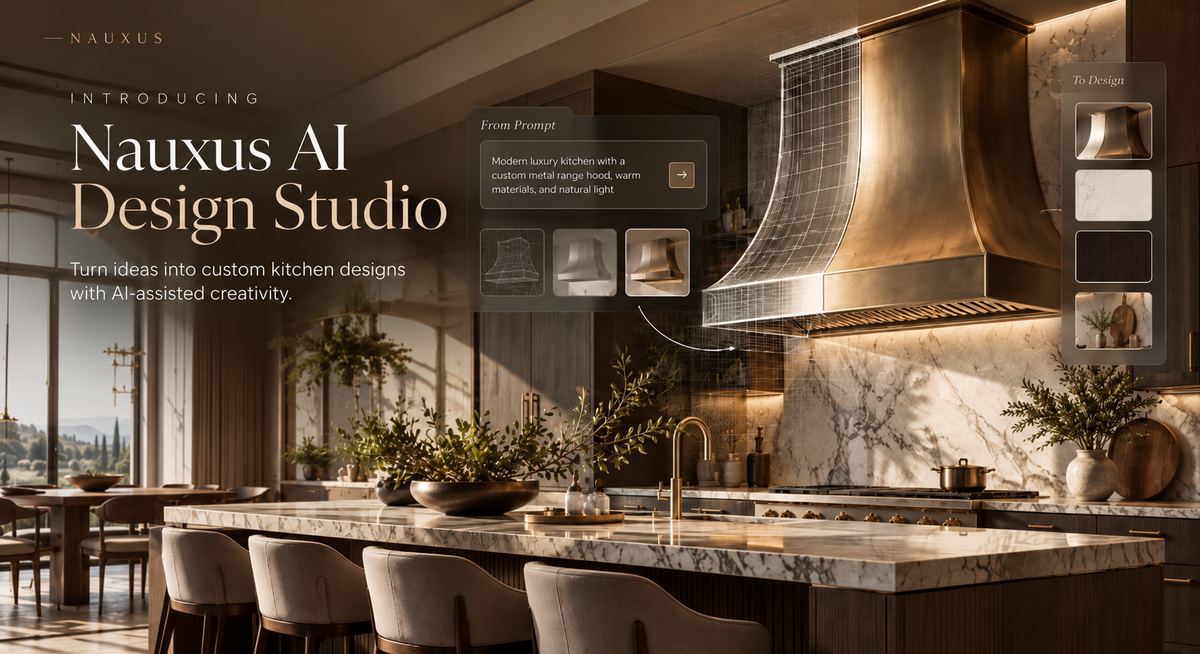
Rather than replacing designers, engineers, or craftsmen, AI can become a new visualization tool—helping homeowners explore ideas earlier, communicate preferences more clearly, and make more informed design decisions before production begins.
From Catalog Shopping to Creative Exploration
For decades, most kitchen product decisions started with a catalog.
A customer browsed existing products, selected the closest available option, and then adjusted the size, finish, or a few decorative details.
That approach still works well for many projects.
But true custom design often begins somewhere else.
It may begin with:
- a kitchen photo
- an architectural rendering
- a saved inspiration image
- a material sample
- a sketch
- a color combination
- or simply an idea that does not yet exist as a product
AI allows the design process to begin with that inspiration instead of forcing the customer to begin with an existing SKU.
That is a significant shift.
Instead of asking:
“Which existing range hood is closest to what I want?”
a homeowner can begin asking:
“What could a range hood designed specifically for this kitchen look like?”
1. AI Makes Kitchen Ideas Easier to Visualize
One of the biggest challenges in custom design is visualization.
A customer may say:
“I want something modern, but not too minimal.”
Or:
“I like copper, but I want the hood to feel lighter and more architectural.”
Or:
“I want brass details, but I do not want the kitchen to feel overly traditional.”
Those are useful descriptions, but they leave considerable room for interpretation.
AI visualization helps turn those words into images.
A customer can begin with a photo of the actual kitchen and explore different approaches to:
- shape
- proportion
- material
- finish
- texture
- decorative accents
- overall design style
Instead of discussing an abstract idea, the homeowner and design team can discuss a visible concept.
That can make the conversation much more specific.
2. AI Allows More Ideas to Be Explored Earlier
Traditional custom design takes time.
Producing several detailed renderings manually can require significant design resources, especially when a customer is still in the early exploration stage.
AI changes the economics of ideation.
A homeowner can explore several visual directions before asking an engineering or production team to develop the final solution.
For example, the same kitchen might be explored with:
Concept A
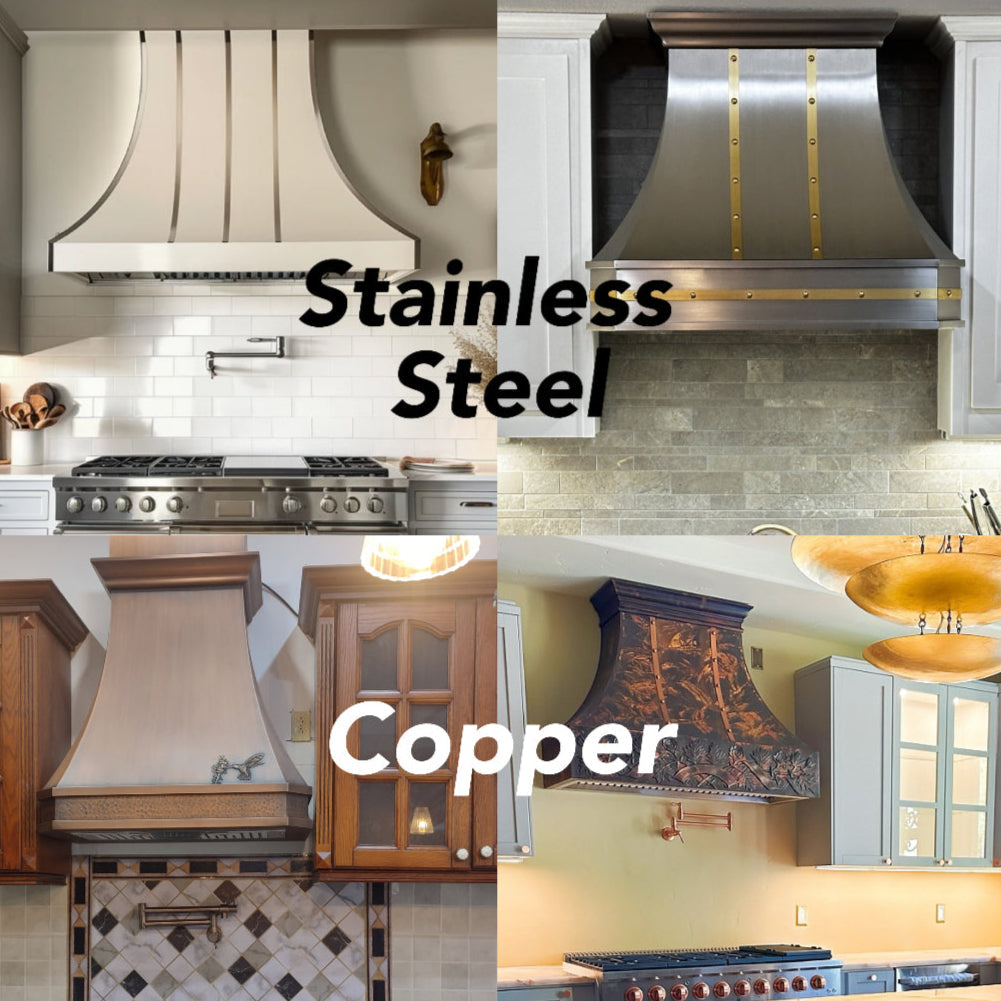
A clean stainless steel box hood with subtle brass trim.
Concept B
A softly tapered copper hood with a light hammered texture.
Concept C
A sculptural dark metal hood with brass straps.
Concept D
A simplified architectural hood with no visible decorative hardware.
The purpose is not to manufacture every concept.
The purpose is to compare possibilities quickly.
This helps customers understand what they actually prefer before investing time in technical development.
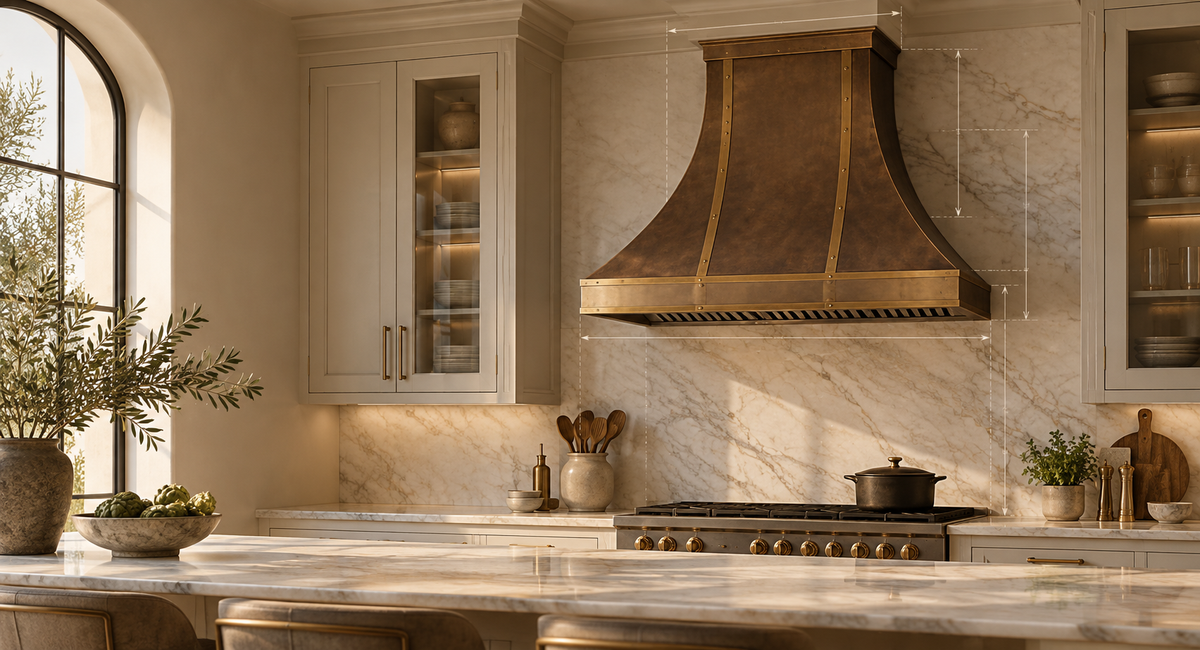
3. AI Can Make Custom Range Hood Design More Flexible
The range hood is often one of the largest visual elements in a kitchen.
Its proportions, material, silhouette, and finish can dramatically change the character of the room.
Traditionally, customers might begin by choosing between a few established shapes:
- bell
- curved
- pyramid
- box
- tapered
- wall mount
- island mount
AI adds another layer.
Instead of only choosing a category, homeowners can explore how that shape interacts with their actual kitchen.
For example:
What happens if the hood becomes slightly wider?
Would an antique copper finish work better than natural copper?
What if brass straps were thinner?
Would a curved apron soften the cabinetry?
Should the hood feel more modern or more handcrafted?
AI helps answer those questions visually.
For custom range hood projects, this is particularly useful because relatively small changes in proportion or detail can produce a very different overall result.
4. AI Can Also Help Reimagine Custom Sinks
Range hoods are not the only kitchen elements that benefit from visual exploration.
Custom sinks can also be highly personalized.
A homeowner may want to explore:
- apron-front designs
- copper or stainless steel
- smooth or hammered textures
- custom bowl dimensions
- rounded or squared forms
- decorative apron details
- different finishes
- unusual proportions
Many of these choices are difficult to imagine from a specification sheet alone.
AI can help customers visualize how a sink might look within the countertop, cabinetry, faucet selection, and surrounding finishes.
This is especially helpful when the sink itself is intended to become a visual feature rather than simply a functional fixture.
5. AI Improves Communication Between Homeowners and Design Teams
Custom projects often involve several people:
- Homeowner
- Designer
- Contractor
- Builder
- Engineer
- Manufacturer
When each person interprets the original idea differently, mistakes become more likely.
AI concepts can become a shared visual reference.
Instead of saying:
“Make it a little more modern.”
a customer can point to a concept and say:
“Keep this silhouette, but remove the lower trim and use the finish from the second version.”
That is a much more actionable conversation.
AI does not eliminate discussion.
It makes discussion more precise.
6. AI Helps Customers Discover Ideas They May Not Have Considered
Custom design is not only about reproducing an existing reference image.
It is also about discovering something new.
A homeowner may begin with a very specific idea:
“I want a copper farmhouse hood.”
But after exploring several concepts, they may discover that a simpler architectural form works better with their cabinetry.
Or they may discover that:
- stainless steel with brass accents works better than copper
- a smooth surface works better than hammered metal
- a wider hood creates stronger proportions
- fewer decorative details make the design feel more premium
This is one of the most valuable uses of AI in design:
not simply producing what was requested, but helping people compare what is possible.
7. AI Does Not Replace Engineering
This distinction is extremely important.
A beautiful AI image is not automatically a manufacturable product.
AI may create shapes or proportions that look visually appealing but do not account for:
- structural requirements
- ventilation
- ducting
- insert dimensions
- mounting conditions
- material limitations
- appliance clearances
- fabrication methods
- installation conditions
That is why AI should be treated as a concept-generation tool, not as a production drawing.
A responsible custom design process still requires professional review.
At Nauxus, an AI concept can become the starting point for a real project—but the concept must still be evaluated for manufacturing feasibility before production begins.
8. From AI Concept to Buildable Design
The most useful AI design workflow does not end with an image.
It continues through several stages.
Step 1 — Inspiration
The customer starts with a kitchen photo, rendering, sketch, or design idea.
Step 2 — AI Exploration
Different product forms, materials, finishes, proportions, and details are explored visually.
Step 3 — Concept Selection
The customer identifies the direction that best fits the kitchen and personal style.
Step 4 — Professional Review
The design team evaluates:
- dimensions
- materials
- construction
- installation
- functionality
- manufacturing feasibility
Step 5 — Technical Development
The selected concept is translated into accurate specifications and, when appropriate, CAD drawings.
Step 6 — Fabrication
The approved design moves into real manufacturing.
This is the point where digital creativity meets physical craftsmanship.
9. AI Can Reduce Design Uncertainty
Custom products require commitment.
Once fabrication begins, changing the size, shape, or major design details can become difficult or expensive.
AI allows more of those decisions to happen earlier.
Before production, customers can compare:
- different finishes
- different shapes
- alternative proportions
- decorative combinations
- stylistic directions
That does not eliminate every uncertainty.
But it gives customers more information before committing to a design.
For high-value custom pieces, that can significantly improve confidence in the final direction.
10. AI Makes Personalization More Accessible
Historically, highly customized design processes were often associated with large projects involving professional designers and extensive rendering work.
AI makes early-stage visualization more accessible.
A homeowner does not need to know professional rendering software.
They can begin with plain language:
“Make the hood more modern.”
“Add refined brass accents.”
“Use a subtle hammered copper texture.”
“Make the sink apron more sculptural.”
This reduces one of the biggest barriers to custom design:
the ability to communicate an idea visually.
11. What AI Cannot Replace
AI is powerful, but custom kitchen design still depends heavily on human expertise.
AI cannot independently replace:
Material Knowledge
Real copper, stainless steel, brass, patina, and hammered finishes behave differently from pixels on a screen.
Engineering
A product must fit the kitchen, support the required components, and meet real installation conditions.
Craftsmanship
Metal still needs to be cut, formed, welded, hammered, polished, finished, and inspected.
Judgment
Not every visually interesting idea is the right design for a particular home.
Human experience remains essential.
The strongest approach is therefore not:
AI instead of craftsmanship.
It is:
AI + design expertise + engineering + craftsmanship.
12. The Role of the Designer Is Changing
AI may also change how professional designers work.
Rather than spending the earliest phase of a project manually illustrating every possible direction, designers can use AI for faster concept exploration.
Their expertise can then focus more heavily on:
- proportion
- material selection
- spatial relationships
- feasibility
- refinement
- technical coordination
- final decision-making
AI becomes another tool in the design process—similar to rendering software, CAD, or physical samples.
The tool changes.
The need for good design judgment does not.
13. Custom Kitchen Design Is Becoming More Collaborative
One of the most interesting consequences of AI is that homeowners can participate more actively in the design process.
Instead of receiving a finished proposal and simply approving or rejecting it, customers can explore ideas with the designer.
The process becomes more iterative:
- What if we change this?
- What if we try another finish?
- What if the hood is wider?
- What if the sink uses the same material?
- What if the entire direction becomes more modern?
This can turn custom design into a genuine collaboration rather than a one-way transaction.
14. From “Choose a Product” to “Create a Product”
Perhaps the biggest change AI brings to custom kitchen design is philosophical.
Traditional ecommerce asks:
Which product would you like to buy?
AI-assisted custom design asks:
What would you like to create?
That shift is particularly meaningful for products such as custom range hoods and sinks, where shape, size, material, and finish can become part of the architecture of the room.
The customer is no longer simply selecting from a catalog.
They are participating in the creation of the product.
The Future of AI in Custom Kitchen Design
AI will almost certainly become more integrated into the design process.
Customers may increasingly be able to:
- upload their kitchen
- change products visually
- explore different materials
- compare finishes
- adjust proportions
- save concepts
- collaborate with designers
- move directly from visualization into engineering review
But the most successful custom design systems will still need something AI alone cannot provide:
the ability to turn an idea into a real, functional, well-made product.
That is where technology and manufacturing must meet.
Leave a comment